
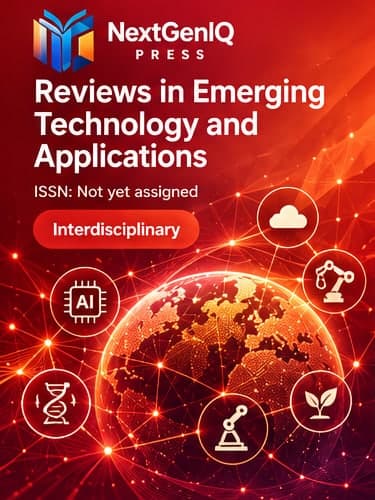
Aims and scope
Full aims and scopeTopics include, but are not limited to:
- Computing, AI & Quantum Systems: Artificial intelligence, intelligent computing, autonomous systems, quantum computing, quantum communications, and next-generation quantum technologies.
- Security, Connectivity & Trust: Cybersecurity, privacy frameworks, trustworthy digital technologies, advanced communications, networking, and connected systems.
- Electronics & Electrical Engineering: Electronics, semiconductor design, photonics, advanced sensing infrastructure, power electronics, and intelligent control mechanisms.
- Robotics, Manufacturing & Automation: Mechanical engineering, robotics, mechatronics, advanced manufacturing, additive manufacturing, and industrial automation.
- Materials, Nanotech & Chemical Processing: Materials science, nanotechnology, functional materials, chemical engineering, process technologies, and industrial biotechnology.
- Energy, Infrastructure & Environment: Renewable energy, energy storage, sustainable systems, civil engineering, resilient infrastructure, environmental engineering, pollution control, resource recovery, water technologies, waste management, and circular-economy solutions.
- Bio-Engineering, Medical & Agriculture: Biomedical engineering, medical devices, advanced healthcare technologies, biotechnology, bioengineering, synthetic biology, agricultural technologies, precision farming, and food engineering.
- Aerospace, Mobility & Physics: Aerospace engineering, space technologies, remote sensing, transportation systems, mobility, marine technologies, applied physics, instrumentation, and measurement technologies.
- Modeling, Governance & Convergence: Computational modeling, simulation frameworks, digital twins, technology convergence, cross-disciplinary applications, reliability assessment, standardization, technology adoption, commercialization paths, governance, and societal impacts.