
Volume 2 · Forthcoming · E-book
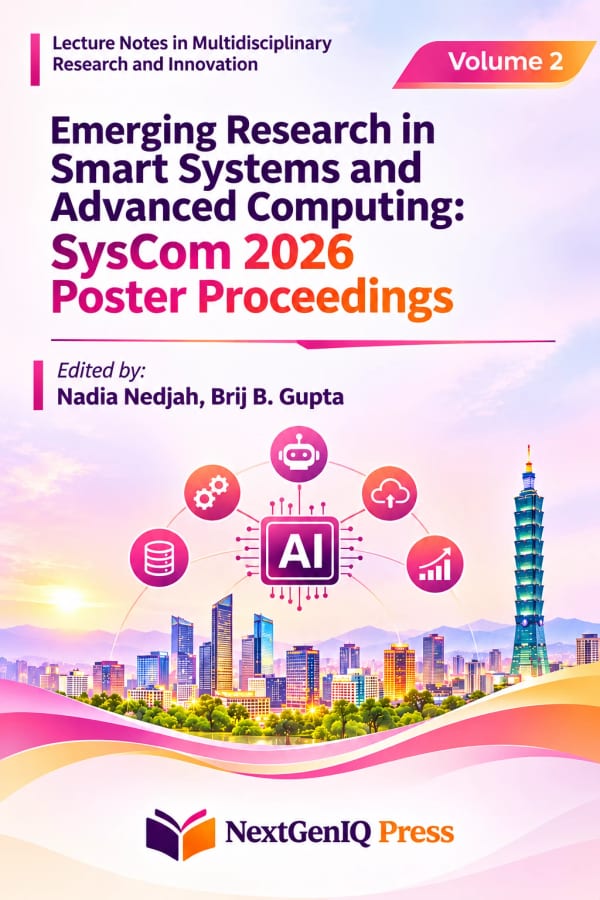
Emerging Research in Smart Systems and Advanced Computing: SysCom 2026 Poster Proceedings
Expected date of publication: January 2027
Pages: 400
Format: E-book
Edited by: Nadia Nedjah (State University of Rio de Janeiro, Brazil) and Brij B. Gupta (Asia University, Taiwan)
- ISBN
- To be assigned
Bibliographic Information
- Series
- Lecture Notes in Multidisciplinary Research and Innovation (LNMRI)
- Volume
- 2
- Editors
- Nadia Nedjah (State University of Rio de Janeiro, Brazil) and Brij B. Gupta (Asia University, Taiwan)
- Publisher
- NextGenIQ Press
- Format
- E-book (PDF)
- Pages
- 400
- ISBN
- To be assigned
- Expected date of publication
- January 2027
Description & Coverage
Emerging Research in Smart Systems and Advanced Computing: Selected Papers from SysCom 2026 Poster Proceedings brings together selected papers from the poster programme of the 3rd International Conference on Smart System & Advanced Computing (SysCom 2026), scheduled for December 19–20, 2026, at Asia University, Taichung, Taiwan. The volume highlights emerging ideas, preliminary research findings, and practical approaches to developing efficient, adaptive, secure, and sustainable computing systems.
Topics span machine learning, deep learning, generative AI, intelligent IoT, cybersecurity, cloud and edge computing, big data analytics, and advanced computational methods. The selected contributions explore applications in healthcare, transportation, industrial automation, robotics, smart cities, and sustainable digital infrastructure, addressing challenges across diverse real-world environments.
Reflecting the exploratory nature of poster presentations, this collection encourages discussion, knowledge exchange, and further research. It offers researchers, academics, postgraduate students, and industry practitioners a resource for exploring emerging methods, applications, and research directions in smart systems and advanced computing.
Coverage:
The many academic areas covered in this publication include, but are not limited to:
- AI, machine learning, and deep learning.
- Generative AI, LLMs, and foundation models.
- Agentic AI and autonomous systems.
- Smart systems and computing architectures.
- IoT and industrial IoT.
- Cybersecurity, network security, and privacy.
- Cloud, edge, and fog computing.
- Big data analytics and decision support.
- Federated learning and distributed computing.
- Blockchain and decentralized applications.
- Intelligent automation and cyber-physical systems.
- Smart healthcare and medical AI.
- Intelligent transportation and smart mobility.
- Smart cities, homes, and sustainable infrastructure.
- Robotics, embedded systems, and autonomy.
- Computer vision and pattern recognition.
- NLP and intelligent information systems.
- Next-generation networks and 5G/6G.
- Digital twins and smart manufacturing.
- Human–computer interaction and human-centered computing.
- Software engineering and intelligent software.
- High-performance and advanced computing.
- Green computing and energy-efficient systems.
- Emerging smart systems and computing applications.
Keywords: Smart Systems, Advanced Computing, AI, IoT, Cybersecurity, Cloud–Edge Computing, Big Data, Blockchain, Robotics, Digital Twins, Sustainable Technologies
Readership: Researchers, academics, postgraduate students, and industry professionals in smart systems, advanced computing, AI, cybersecurity, IoT, and intelligent automation.
Table of Contents
Coming soon.
Editor Bios
Nadia Nedjah
State University of Rio de Janeiro, Brazil
Nadia Nedjah is a full professor in the Department of Electronics Engineering and Telecommunications at the State University of Rio de Janeiro. She earned a computer engineering degree (1987) and a master’s degree in computer systems (1990) from the University of Annaba, Algeria, and a PhD in computation (1997) from the University of Manchester Institute of Science and Technology. Her research covers embedded systems, automatic synthesis of digital circuits, FPGA architectures, encryption hardware, intelligent systems, swarm intelligence, neural networks, machine learning, and swarm robotics. She is the author of three books, more than 120 journal articles, about 40 book chapters, and about 180 conference papers, and she has edited more than 48 books and organised about 25 journal special issues, including issues of Applied Soft Computing, Neurocomputing, and Computers and Electrical Engineering.
Since 2007 she has been editor-in-chief of the International Journal of Innovative Computing Applications and the International Journal of High Performance Systems Architecture, both published by Inderscience, and she is an associate editor of journals including the Journal of Ambient Intelligence and Humanized Computing, the International Journal of Bio-inspired Computation, the International Journal of Electronics, Microprocessors and Microsystems, Integration: The VLSI Journal, and IET Computers and Digital Techniques. She has received five UERJ Prociência scholarships (2009–2024), five CNPq research-productivity scholarships (2007–2026), and three FAPERJ Scientist of Our State awards (2015–2025). She served on the board of the Brazilian Society of Computational Intelligence from 2015 to 2025, coordinated the Intelligent Systems research group in UERJ’s postgraduate programme in electronic engineering, and is a permanent member of Algeria’s National Economic, Social and Environmental Council.
Brij B. Gupta
Asia University, Taiwan
Brij B. Gupta (Senior Member, IEEE) is a distinguished professor in the Department of Computer Science and Information Engineering and the director of the International Center for AI and Cyber Security Research and Innovations (CCRI) at Asia University, Taiwan. He also serves as an adjunct professor at the University of Ottawa, Canada, and Korea University, South Korea. Professor Gupta has a PhD in computer science and engineering and over 20 years of academic and research experience. He has authored more than 500 high-quality research papers, over 35 books, and holds multiple patents. He is recognized globally for his outstanding research contributions, and since 2020, he has been consistently ranked among the top 2% of scientists worldwide by Stanford University and Elsevier. He is also a Clarivate Highly Cited Researcher (top 1%) in computer science, reflecting his exceptional research impact.
Professor Gupta has received numerous prestigious national and international awards, including the Canadian Commonwealth Scholarship, Faculty Research Fellowship Award, IEEE GCCE Outstanding Paper Award, and multiple Best Paper and Best Faculty Awards. He actively contributes to the global research community through editorial leadership roles, serving as editor-in-chief and editorial board member for several high-impact international journals. He has also served as a Distinguished Lecturer of the IEEE Consumer Technology Society and as a Member-at-Large on its Board of Governors, along with key roles in organizing and chairing numerous top-tier IEEE conferences.
His research spans artificial intelligence, cybersecurity, blockchain technologies, cloud and edge computing, intrusion detection systems, cyber-physical systems, and social network analysis. He has been actively involved in international collaborations, interdisciplinary research, and mentoring students and researchers at the undergraduate, postgraduate, and doctoral levels.