
Volume 1 · Forthcoming · E-book
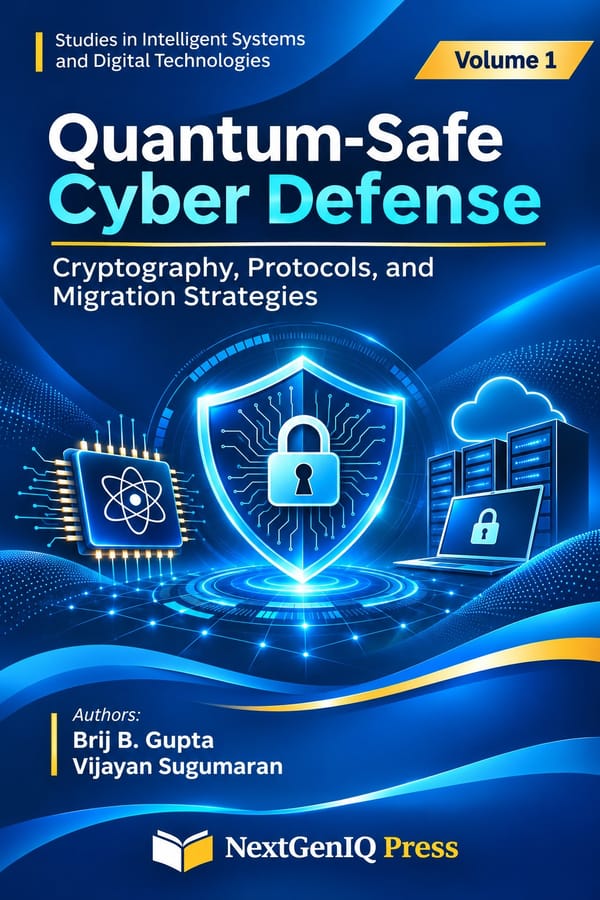
Quantum-Safe Cyber Defense: Cryptography, Protocols, and Migration Strategies
Expected date of publication: November 2026
Pages: 180
Format: E-book
Authors: Brij B. Gupta (Asia University, Taiwan) and Vijayan Sugumaran (Oakland University, USA)
- ISBN
- 978-626-93492-0-3
Bibliographic Information
- Series
- Studies in Intelligent Systems and Digital Technologies (SISDT)
- Volume
- 1
- Authors
- Brij B. Gupta (Asia University, Taiwan) and Vijayan Sugumaran (Oakland University, USA)
- Publisher
- NextGenIQ Press
- Format
- E-book (PDF)
- Pages
- 180
- Price (e-book)
- US $120.00 (NT$4,000)
- ISBN
- 978-626-93492-0-3
- Expected date of publication
- November 2026
Description & Coverage
Quantum-Safe Cyber Defense: Cryptography, Protocols, and Migration Strategies provides a comprehensive exploration of emerging quantum computing threats and the development of quantum-resistant cybersecurity mechanisms. The book focuses on the theoretical foundations, cryptographic algorithms, security protocols, and practical strategies required to protect modern digital infrastructures against the evolving challenges of the quantum computing era.
This book brings together fundamental concepts, advanced cryptographic techniques, emerging security standards, and practical implementation strategies for quantum-safe cybersecurity. The book also explores applications in cloud computing, the Internet of Things (IoT), edge computing, industrial systems, and next-generation communication networks, highlighting implementation challenges, performance evaluation, and future research opportunities.
Coverage:
The many academic areas covered in this publication include, but are not limited to:
- Quantum computing fundamentals and cybersecurity implications.
- Quantum algorithms and threats to conventional cryptographic systems.
- Mathematical foundations of post-quantum cryptography.
- Lattice-based, code-based, and hash-based cryptographic algorithms.
- Quantum-resistant key encapsulation mechanisms and digital signatures.
- NIST post-quantum cryptographic standards and security frameworks.
- Quantum-safe authentication, key management, and digital certificates.
- Post-quantum TLS, VPNs, IPsec, and secure communication protocols.
- Quantum-resistant network security architectures and Zero Trust frameworks.
- Lightweight post-quantum cryptography for IoT and embedded systems.
- Quantum-safe security for cloud, edge, and 5G/6G networks.
- Cryptographic agility, hybrid cryptography, and interoperability.
- Quantum risk assessment and post-quantum migration strategies.
- Performance optimization, side-channel attacks, and security evaluation.
- Standardization, implementation challenges, and future research directions.
Keywords: Post-Quantum Cryptography, Quantum-Safe Cybersecurity, Quantum-Resistant Cryptography, Quantum Computing, Cryptographic Agility, Lattice-Based Cryptography
Readership: This book is intended for researchers, academicians, postgraduate students, cybersecurity professionals, cryptographers, network security engineers, and industry practitioners interested in post-quantum cryptography and quantum-resilient cybersecurity.
Table of Contents
- Chapter 1Quantum Computing and the Evolving Cybersecurity Threat Landscape: Foundations, Challenges, and Security ImplicationsBrij B. Gupta, Vijayan SugumaranDownload this chapterUS $25.00NT$800
- Chapter 2Post-Quantum Cryptography: Mathematical Foundations, Quantum-Resistant Algorithms, and Security ModelsBrij B. Gupta, Vijayan SugumaranDownload this chapterUS $25.00NT$800
- Chapter 3Quantum-Safe Cryptographic Protocols: Key Encapsulation, Digital Signatures, and Secure CommunicationBrij B. Gupta, Vijayan SugumaranDownload this chapterUS $25.00NT$800
- Chapter 4Quantum-Resistant Network Security Architectures: Secure Transport, Authentication, and Key ManagementBrij B. Gupta, Vijayan SugumaranDownload this chapterUS $25.00NT$800
- Chapter 5Quantum-Safe Security for Cloud, IoT, Edge Computing, and Next-Generation Communication NetworksBrij B. Gupta, Vijayan SugumaranDownload this chapterUS $25.00NT$800
- Chapter 6Cryptographic Agility and Post-Quantum Migration: Risk Assessment, Hybrid Cryptography, and Transition FrameworksBrij B. Gupta, Vijayan SugumaranDownload this chapterUS $25.00NT$800
- Chapter 7Implementation Challenges and Security Evaluation of Post-Quantum Cryptographic Systems: Performance, Vulnerabilities, and DeploymentBrij B. Gupta, Vijayan SugumaranDownload this chapterUS $25.00NT$800
- Chapter 8Emerging Trends in Quantum-Safe Cyber Defense: Standardization, Quantum-Resilient Infrastructures, and Future Research DirectionsBrij B. Gupta, Vijayan SugumaranDownload this chapterUS $25.00NT$800
Author Bios
Brij B. Gupta
Asia University, Taiwan
Brij B. Gupta (Senior Member, IEEE) is a distinguished professor in the Department of Computer Science and Information Engineering and the director of the International Center for AI and Cyber Security Research and Innovations (CCRI) at Asia University, Taiwan. He also serves as an adjunct professor at the University of Ottawa, Canada, and Korea University, South Korea. Professor Gupta has a PhD in computer science and engineering and over 20 years of academic and research experience. He has authored more than 500 high-quality research papers, over 35 books, and holds multiple patents. He is recognized globally for his outstanding research contributions, and since 2020, he has been consistently ranked among the top 2% of scientists worldwide by Stanford University and Elsevier. He is also a Clarivate Highly Cited Researcher (top 1%) in computer science, reflecting his exceptional research impact.
Professor Gupta has received numerous prestigious national and international awards, including the Canadian Commonwealth Scholarship, Faculty Research Fellowship Award, IEEE GCCE Outstanding Paper Award, and multiple Best Paper and Best Faculty Awards. He actively contributes to the global research community through editorial leadership roles, serving as editor-in-chief and editorial board member for several high-impact international journals. He has also served as a Distinguished Lecturer of the IEEE Consumer Technology Society and as a Member-at-Large on its Board of Governors, along with key roles in organizing and chairing numerous top-tier IEEE conferences.
His research spans artificial intelligence, cybersecurity, blockchain technologies, cloud and edge computing, intrusion detection systems, cyber-physical systems, and social network analysis. He has been actively involved in international collaborations, interdisciplinary research, and mentoring students and researchers at the undergraduate, postgraduate, and doctoral levels.
Vijayan Sugumaran
Oakland University, USA
Vijayan Sugumaran is Distinguished University Professor and Janke Scholar of Management Information Systems at Oakland University, where he chairs the Department of Decision and Information Sciences, co-directs the Institute for Data Science, and directs the Master of Science in Business Analytics. He joined the faculty in 1999, became a professor in 2007, and was named Distinguished Professor in 2020. He received his Ph.D. in information technology from George Mason University. His research covers big data management and analytics, ontologies and the semantic web, and intelligent and multi-agent systems. He has published more than 350 peer-reviewed articles and has edited twenty books, with work in Information Systems Research, ACM Transactions on Database Systems, Communications of the ACM, and several IEEE transactions.
He is editor-in-chief of the International Journal of Intelligent Information Technologies and the Journal of Web Engineering, and he serves on the editorial boards of eight journals. He is co-principal investigator on a $2 million National Science Foundation grant (2023–2028) to train students in data science and entrepreneurship, and he has also held grants from the Korea Research Foundation and the Research Grants Council of Hong Kong. In 2025 SAS named him a SAS Educator for leadership in data and artificial-intelligence education; student teams he guided won the energy track of the SAS Hackathon in 2024 and the forecasting track in 2023. He received Oakland University’s Research Excellence Award in 2010, was a Fulbright Specialist in 2012, and was a visiting professor at Sogang University in Seoul and an international expert at Shanghai University. He has chaired the Intelligent Agent and Multi-Agent Systems track at the Americas Conference on Information Systems since 1999 and has been program chair of conferences including NLDB, ACIS, and the IEEE International Conference on Big Data Service and Applications.